

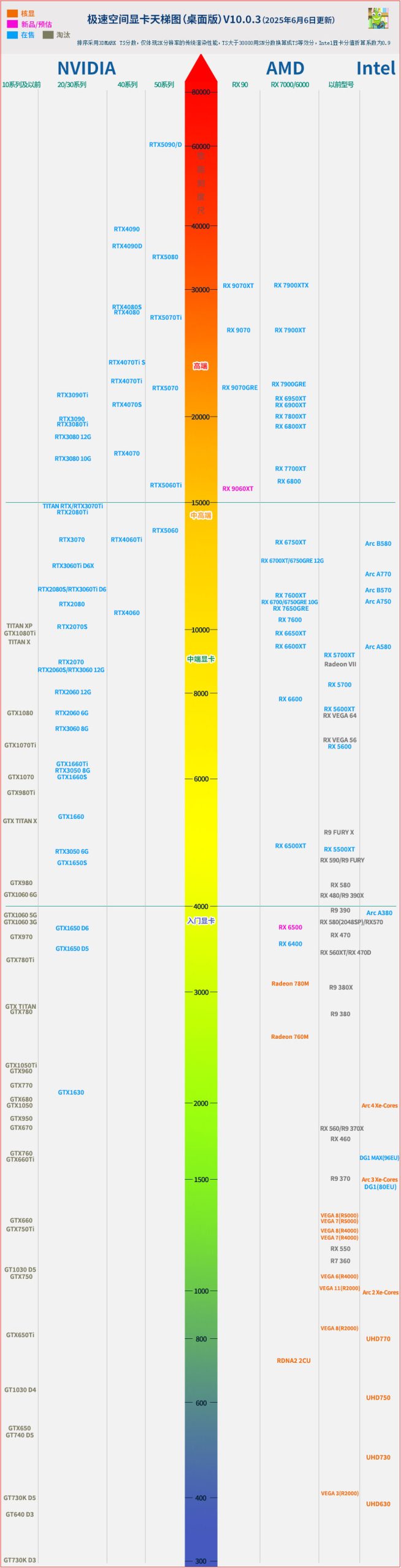
1. What Is a GPU Performance Tier List?
A GPU performance tier list is a reference chart or website that shows the relative performance levels and prices of graphics cards currently available on the market. These graphics cards are ranked according to their performance and price, arranged from the most powerful to the least powerful.
By using a GPU tier list, users can quickly understand how different graphics cards compare in terms of performance and cost, making it easier to choose the model that best suits their needs and budget.
2. GPU Tiers and Manufacturers
Graphics cards are categorized into different tiers based on their performance levels, while manufacturers refer to the companies that produce them. Common GPU brands include NVIDIA, AMD, and Intel.
In most GPU tier lists, graphics cards are typically divided into three main categories: entry-level, mid-range, and high-end. Entry-level GPUs are generally suitable for office work and light gaming. Mid-range GPUs are designed for gaming and entertainment, offering better performance and visual quality. High-end GPUs, on the other hand, are intended for demanding games and professional workloads such as content creation and 3D rendering.
3. GPU Performance
The performance of a graphics card is mainly determined by its internal processor (GPU) and memory. In GPU tier lists, each graphics card’s performance is usually represented by a numerical value, most commonly measured in FPS (frames per second). The higher the FPS, the better the GPU’s performance.
When choosing a graphics card, it is important to understand both its performance level and the available brands on the market. NVIDIA and AMD are currently the two leading GPU manufacturers, both offering high-quality products with extensive product lines to meet a wide range of user needs.
On the market, graphics cards are divided into different performance tiers. The higher the tier, the faster the card runs and the better the visual output. GPUs are generally classified into entry-level, mid-range, high-end, and flagship categories.
Entry-level graphics cards can handle basic graphical tasks such as video playback and simple games. Mid-range GPUs provide stronger performance, supporting higher resolutions and better visual quality, making them suitable for gamers and users who work with larger images or videos. High-end and flagship GPUs support even higher resolutions and graphical settings, and are capable of running the latest 3D games and other applications that require high-performance graphics processing.
Additional Factors That Affect GPU Performance
Beyond performance tiers, several other factors can influence a graphics card’s overall performance, including GPU core clock speed, memory clock speed, and memory capacity. Higher clock speeds and larger memory sizes generally result in faster processing and improved visual output.
Manufacturing process technology also plays an important role. Current GPUs are produced using processes such as 14nm, 12nm, and 7nm. In general, the smaller the manufacturing process, the more powerful and efficient the graphics card tends to be.
Why Use a GPU Tier List?
A GPU tier list is a practical tool designed to help users choose the right graphics card. By organizing GPUs into different tiers based on performance and price, and presenting them in a clear visual chart, users can easily compare options and select the GPU that best fits their requirements and budget.
The explanations above are meant to provide some basic background knowledge. This article mainly focuses on presenting the latest GPU performance tier list, but showing only the chart without any explanation would feel a bit odd ⊙▽⊙
You may also want to refer to:
Beginner’s Guide: How to Quickly Identify GPU Tiers, Models, and Performance Levels
Reference GPU Models Gallery
